South Korea is the most consistently surprising country I've visited. Seoul is a city of 10 million people that runs with a precision most cities of 100,000 can't manage, has a food and nightlife culture that rivals any city in Asia, and sits 60 kilometers from one of the most heavily militarized, and most surreal, borders on earth. The combination of ultra-modern urban life and that geopolitical reality makes it unlike anywhere else. These are the five things I'd build any South Korea trip around.
Trip Brief
Best For
Trip Length
7–10 days
Best Months
April–June (cherry blossoms, mild) and September–November (fall foliage)
Budget Range
Value: $2,500–$4,000/person
Comfortable: $4,500–$7,000/person
Luxury: $8,000–$14,000/person
Who Should Skip It
Travelers who need everything in English. Seoul is increasingly English-friendly but navigating off the tourist path still requires comfort with Korean signage.
The DMZ Joint Security Area tour, the most surreal experience in Asia
The Demilitarized Zone between North and South Korea is a 4-kilometer-wide, 250-kilometer-long strip of land that has been essentially untouched since the 1953 armistice. It is also one of the most biologically diverse areas in the Korean Peninsula: decades of human absence have produced an inadvertent nature reserve. The Joint Security Area at Panmunjom, where the two Koreas technically face each other across a table, is the most surreal physical experience available to a traveler: you stand in a room that is simultaneously inside North and South Korea, watched by soldiers on both sides who do not move or speak. The access is tightly controlled and requires a guided tour from Seoul, US military oversight, and specific dress code compliance. Do it.
Gyeongbokgung Palace at opening - in hanbok if you're willing
Gyeongbokgung, the 14th-century royal palace in the heart of Seoul, is the largest and most impressive of the Five Grand Palaces. At 9am when it opens, before the tour groups arrive, you can walk the enormous grounds in relative solitude. Hanbok rental, traditional Korean dress, is available at shops throughout the Bukchon neighborhood and gives you free entry to all five palaces. The sight of the palace gates reflected in the pool, with the mountains behind Jongno-gu visible over the walls, is the clearest reminder that Seoul is built on top of a much older city.
Gwangjang Market at midnight - bindaetteok and soju
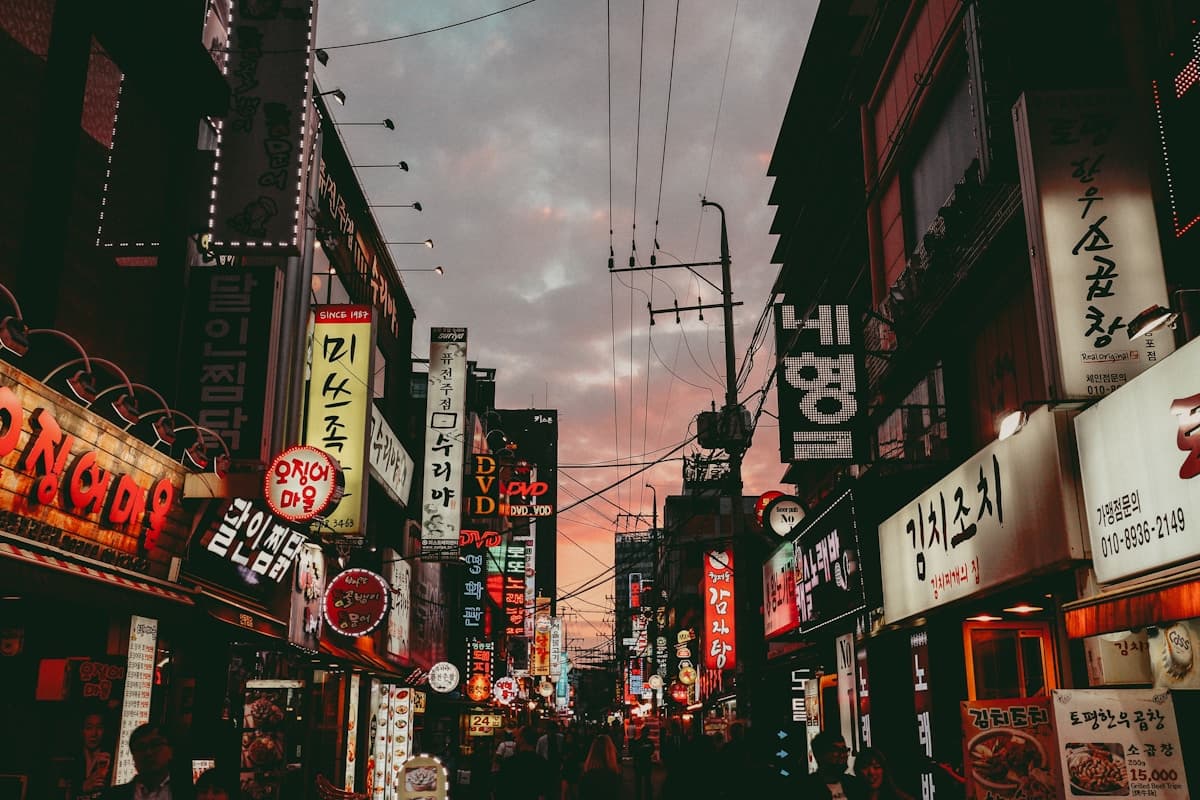
Gwangjang Market is Seoul's oldest continuously operating market, established in 1905. During the day it's famous for its fabric section and its food stalls: bindaetteok (mung bean pancakes), mayak gimbap (small seaweed rice rolls), and pajeon (green onion pancake). At midnight, the food stalls are still running, the ajummas (older Korean women who run the stalls) are still working, and the soju is flowing. The combination of fluorescent light, the sound of batter hitting hot oil, and the dense crowd creates an atmosphere I haven't encountered at any other market anywhere. Go late. Sit at a stall. Eat everything they put in front of you.
Korean BBQ done properly - samgyeopsal with the full spread
Korean BBQ: pork belly grilled at the table, wrapped in lettuce with garlic, sliced chilies, and ssamjang paste, chased with soju, is one of the great communal food experiences in the world. The tourist BBQ restaurants in Myeongdong are fine. The locals-only restaurants in Mapo-gu, near Hongik University, are better. Look for restaurants with a line out the door and a haze of charcoal smoke at the entrance. The full experience: multiple banchan (side dishes) arriving before you've ordered, the charcoal brought to the table, the scissors for cutting the meat, takes longer than you expect and is more enjoyable than you can anticipate going in.
Bukhansan, a national park inside a city of 10 million people
Bukhansan National Park, in the northern part of Seoul, is the most visited national park per unit area in the world. The granite peaks: Baegundae at 836 meters is the highest: rise right out of the city's residential neighborhoods. Accessible by subway. On a weekday morning, the forest trails to the ridge are quiet, and the view from the summit: Seoul's entire sprawl extending to the horizon, stops you. There are temple complexes centuries old in the valleys below the peaks. Mountain trail, ancient temple, subway home: all inside a city of 10 million people. That's just what Seoul is.
Come to South Korea curious rather than with a checklist. The history is dense, the food is serious, and the DMZ is unlike any day trip available from any other capital city on earth. Three days minimum; five is better.
Seoul is one of the most underrated group travel destinations in Asia.
Tell us your group size and travel dates. We'll build the Seoul itinerary that goes beyond the obvious - Gyeongbokgung and Gangnam, plus the neighborhoods that don't make the guidebooks.
Written by
Eric