Singapore is the easiest place in Asia to arrive at and the most deceptive. The efficiency, the cleanliness, the organization, all of it is real, but so is a food culture that UNESCO has declared an intangible cultural heritage, a botanical garden that has been developing for 160 years, and neighborhoods whose distinct cultural layers have been preserved with a care unusual for a city that's rebuilt itself as aggressively as Singapore has. These are the five things I'd tell anyone before they go.
Trip Brief
Best For
Trip Length
5–7 days (or as a stopover on a longer Asia trip)
Best Months
February–April (least rain). Singapore is warm year-round.
Budget Range
Comfortable: $3,500–$6,000/person
Luxury: $7,000–$14,000/person
Who Should Skip It
Travelers looking for untouched, un-curated travel experiences. Singapore is extraordinarily well-organized, some travelers find that too polished. It's a feature, not a bug.
Hawker centers - the world's best street food in air-conditioned comfort
Singapore's hawker centers are open-air food courts where individual stalls specialize in single dishes, often refined over generations. Maxwell Food Centre, Lau Pa Sat, and Old Airport Road are the most famous. Tian Tian Chicken Rice at Maxwell has had a Michelin Bib Gourmand. Hill Street Tai Hwa serves what many consider the finest bak chor mee (pork noodles) in Singapore and consistently has a 45-minute queue. The Singaporean government's decision to preserve the hawker center culture, resisting the push from developers to replace them with restaurants, is one of the finest urban policy decisions I've seen anywhere. Eat at three different centers, at three different meals, on your first day. Start at Maxwell for breakfast.
Gardens by the Bay at night: the Supertrees light show
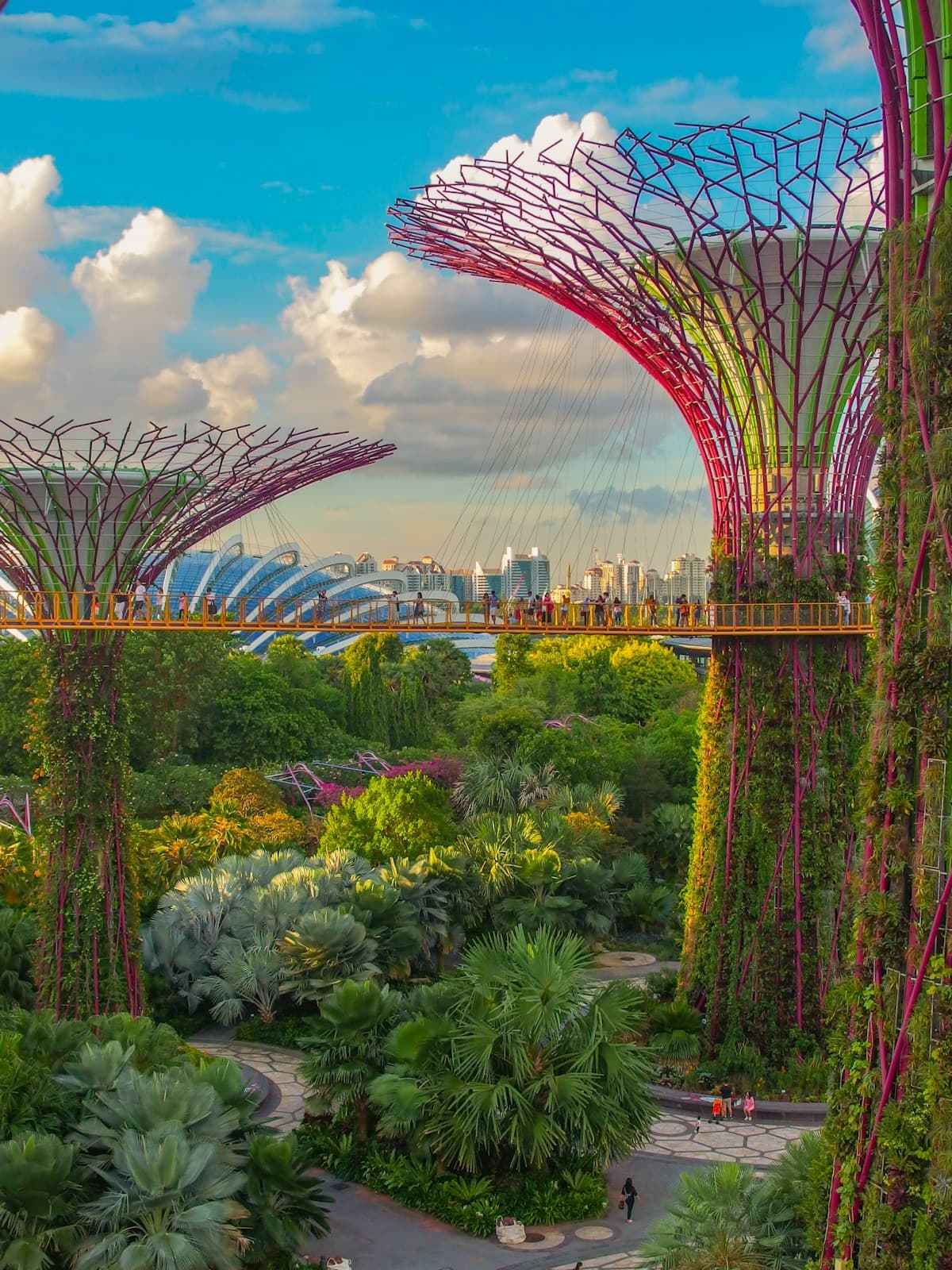
Gardens by the Bay's Supertree Grove: 18 tree-like structures between 25 and 50 meters tall, covered in 162,900 plants, is already striking in daylight. At 7:45pm and 8:45pm, the OCBC Garden Rhapsody light and sound show runs. The show itself is fine; the setting does the real work. Walking through the grove at night with the Supertrees lit up above you and the Marina Bay skyline behind them is the best free experience in Singapore. The Cloud Forest and Flower Dome conservatories (ticketed) are worth a morning, especially the Cloud Forest's indoor waterfall and the elevated mountain walk.
Walk from Boat Quay through Chinatown to Little India, the entire city in an afternoon
Singapore's compact geography makes this doable: walk through four distinct cultural quarters in a single afternoon. Start at Boat Quay (colonial financial district, now restaurants) and head southwest through Chinatown's temples and shophouses into Little India, where Serangoon Road on a Sunday is one of the more sensory experiences in Asia: sari shops, garland sellers, incense, temple bells, food stalls. The contrast between these neighborhoods: some carefully preserved, some reconstructed, gives you a clear picture of how Singapore has been put together.
The Singapore Sling at Raffles Long Bar: yes, the tourist thing
The Long Bar at Raffles Hotel, where the Singapore Sling was invented in 1915, is unambiguously a tourist experience. The drink is overpriced. Peanut shells on the floor, historical affectation. It's crowded. And yet: Raffles has been carefully restored, the Long Bar is a proper colonial-era room, and drinking a historically significant cocktail in the place it was invented is something you either do or you don't. I did it. Glad I did. Order the Sling, eat the peanuts, take in the room. Then go eat at a hawker center.
Jewel Changi Airport - even if you're not flying
Changi Airport's Jewel terminal is a glass-domed garden with the world's largest indoor waterfall: the Rain Vortex, 40 meters tall, falling from the dome apex into a forest of 2,000 trees. It's the best airport in the world and worth visiting even if you have no flight. Take the MRT to the airport, walk through the forest terrace levels, eat at one of the restaurants, look at the waterfall. The fact that Singapore built essentially a public garden inside its primary international airport tells you something specific about this country that no other example can.
Singapore rewards a slow pace more than most people give it. The tendency is to rush through it as a layover, but two full days (one on food and neighborhoods, one on the bigger attractions) gives you a complete picture of a place unlike anywhere else. Don't rush it.
Singapore is one of the best corporate group destinations in Asia.
Tell us your group size, dates, and whether Singapore is the destination or a stopover. We'll build it accordingly.
Written by
Eric